Solving the Donor Concentration Problem: Why Impact Stories Matter
February 11, 2026
By Kacie Escobar, MBA, APR
Through our work with cultural organizations, we’ve had a front-row seat to the evolving philanthropic landscape. In communities with deep cultural identity and concentrated wealth, replacing lost funding often means leaning harder on private philanthropy.
A recent Arts Beat article captured the fragility of that system. Leaders in Sarasota described a donor base where much of the support traces back to 10 to 12 individuals who help drive the community’s cultural life. Lose one, and it can take 10 more to fill the gap.
That dynamic is not unique to Sarasota. Nationally, funding uncertainty is forcing nonprofits to adjust. In one recent poll, 45% of nonprofits said some of their federal funding in 2025 was canceled or not renewed.
Diversifying revenue almost always includes finding new donors. But new donors are often unknown to you. They also tend not to convert into major-gift supporters at the speed needed to cover immediate shortfalls.
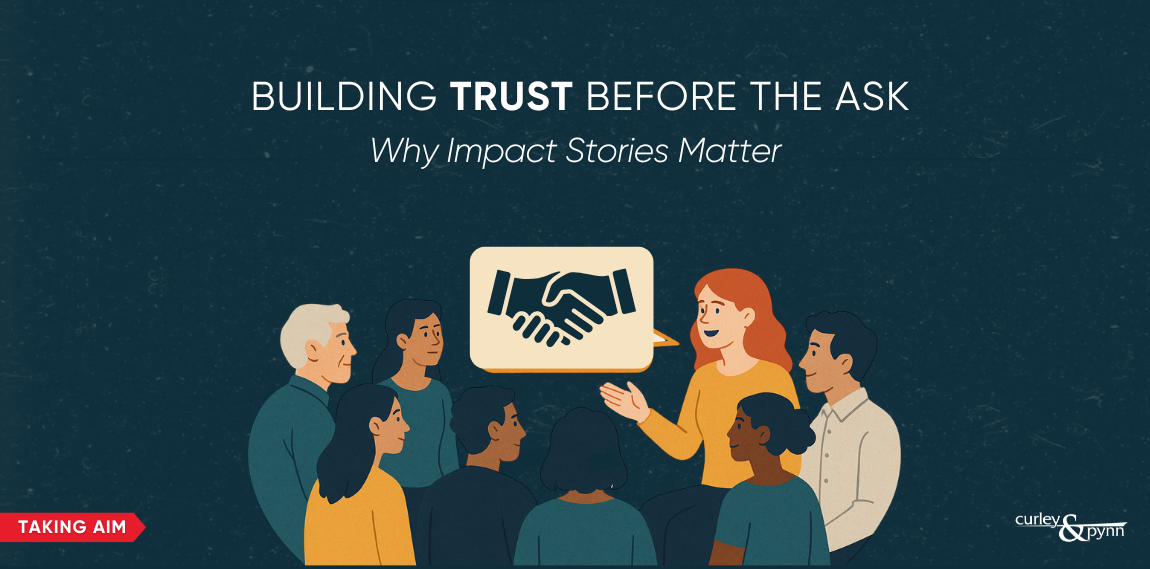
To be clear, more communication alone won’t solve this. But strategic communications can support long-term fundraising by building social capital — the trust, familiarity, and shared identity that make people want to be associated with your mission and willing to advocate for it.
That’s where impact stories come in. They’re one of the fastest and most scalable ways to build social capital because they translate mission into lived experience: Here’s who you helped. Here’s what changed. Here’s why it matters.
They help you earn the right to make the ask.
Public storytelling also improves discoverability. When your impact is consistently visible, people who care about your cause can find you, understand you quickly and see proof that their support would matter. That’s how you widen the circle before you need to rely on it.
Think about how relationships work in real life. As they saying goes, “You don’t walk up to a stranger and ask them to help you move.” You show up. You share values. You prove you’re worth trusting. Major gifts are no different. Stories build relationship equity at scale, so when you invite someone to give, it feels earned and not abrupt.
The strongest campaigns build both:
- Relationship equity: Trust with an individual donor.
- Social capital: Trust with the broader network and community around your organization.
You can have one without the other. A beloved major donor may support quietly, even if the organization isn’t widely understood. Or an organization may have broad goodwill without deep individual relationships. Impact stories help close both gaps.
When stories are personal and tailored — “This reminded me of why you care” — they build relationship equity. This is often where the fundraising team leads.
When stories are consistent and public-facing — “This is clearly valuable; others support it; it’s working” — they build social capital. This is where marketing often leads.
Another way to think about it: Every interaction is either a deposit or a withdrawal from someone’s emotional bank account. Storytelling is a deposit. It adds value, creates transparency and strengthens connection.
Do it consistently through email, social, earned media and everything in between, and you keep the engine running year-round. Then, when it’s time to infuse campaign messaging or request a major gift, you’re not starting cold; you’re building on trust that’s already there.