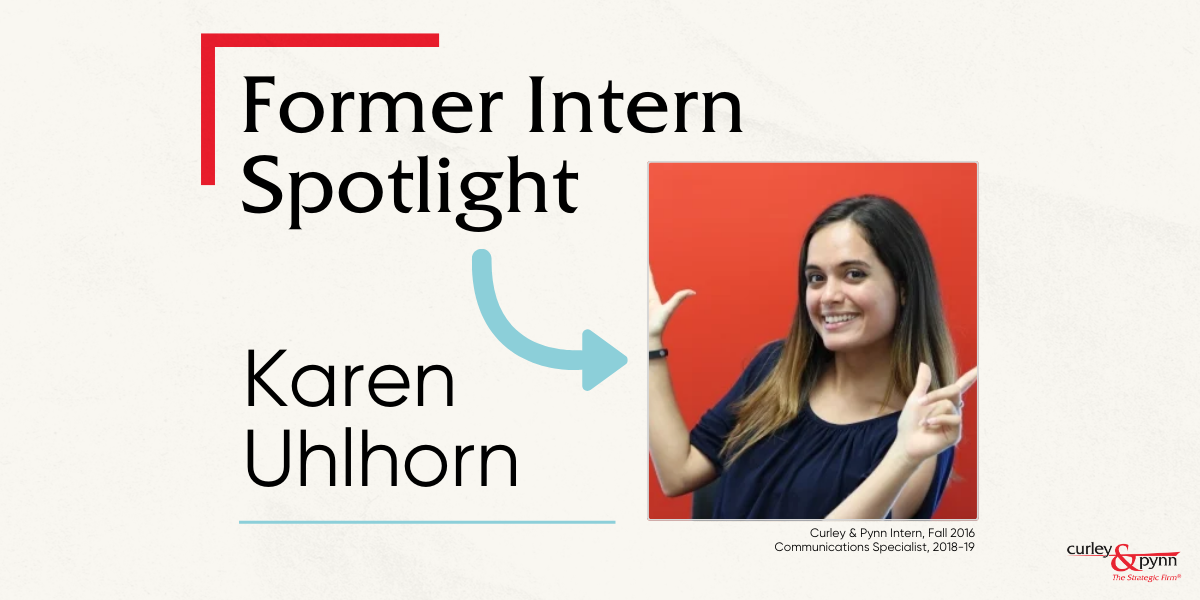
Where Are They Now: Former Intern Karen Uhlhorn
March 18, 2026
By Curley & Pynn
Karen (Kacir) Uhlhorn joined Curley & Pynn in Fall 2016 as a student intern ready to make an impact for clients. She did just then and even went on to earn a full time role with the firm in 2018 as a public relations specialist.
Today, Karen is the director of Operators at OrphasWise – a nonprofit that seeks to connect the best tools and training to those who work with children from hard places. Below, Karen shares what her time at C&P meant to her and even offers advice to up and coming interns.
Would you describe the phase of your career you’re in right now, and what feels most meaningful about the work you’re doing?
I currently hold two robust part-time roles. I serve as Director of Operations at CareEQUIP (formerly OrphanWise), a nonprofit providing trauma-informed training and resources to parents and professionals who work with children who come from backgrounds of adversity. I also serve as a fractional CMO for Thrive Clinic, a rapidly growing functional medicine and nutrition practice based in Southern Pines, North Carolina.
Though very different organizations, both roles share a common goal: bringing healing and hope into places where there was formerly dysfunction. I never have to wonder whether my work makes a real, positive difference. Whether it’s patients at the clinic or families in our programs, I regularly hear some variation of “this changed my life.” That’s incredibly grounding.
I’ve also been fortunate to work with leaders who trust my judgment, giving me room to try new ideas, experiment, occasionally fail, and refine. That trust has accelerated my growth more than any formal title could.
If I had to label this phase, I’d call it mid-career growth. I earned my PMP several years ago and recently became a Salesforce Certified Administrator, credentials that have expanded both my strategic and technical capabilities and opened doors to work I genuinely enjoy.
What did the C&P internship change for you — in how you think, how you work, or how you see yourself as a professional? How did this carry forward into other roles?
I reference my time at C&P at least once a week, whether I’m applying best practices for securing media coverage, managing an event timeline, or even recalling oddly specific trivia about solar energy or theme park operations.
Although I’d held internships before, C&P was the first place I truly had to operate with ownership. The expectations were high, and the work mattered. I had to think strategically, communicate clearly, and represent clients with confidence.
Ironically, I wasn’t originally slated to intern there. A last-minute opening allowed me to step in before leaving for Peace Corps. I was top of mind to the intern program manager because I’d skipped walking at my college graduation to attend the FPRA convention, where I introduced myself to Roger Pynn, who spoke highly of me to her. That moment taught me something I’ve carried ever since: initiative compounds.
Competence will open doors, but initiative, curiosity, and the willingness to raise your hand often determine whether you’re invited into the room in the first place.
C&P also changed how I see myself professionally. It was the first time I understood that I didn’t just want to “do good work” — I wanted to contribute meaningfully, to bring something distinct to the table, and to earn trust. That mindset has followed me into every role since.
And with time, I’ve come to appreciate something else: careers are rarely self-made. They are shaped by people who notice you, advocate for you, and give you opportunities before you feel entirely ready. I’m deeply grateful for that.
As someone with several years of experience now, what do you most appreciate about the internship experience that you couldn’t fully see or value at the time?
Ownership and accountability.
As both an intern and later a specialist, I was encouraged to bring something of value to every client interaction. There was a clear expectation that every person at C&P pulled their weight and contributed meaningfully to the team’s success.
I also developed scrappiness. If you don’t know how to do something: ask, research, figure it out, make it work. That mindset proved invaluable in more resource-limited environments, especially during Peace Corps service and later nonprofit leadership roles.
What’s one piece of advice you’d give a current intern or student who’s feeling unsure about their career direction right now?
The Rocks/Gravel/Sand analogy comes to mind. For your career trajectory to make sense, you have to be honest about your full set of priorities, because your career is likely only one of many things you value.
For me, career has often been “gravel” compared to the “rocks” of faith, marriage, and a commitment to work that brings meaningful, positive change into the world. Once you know your rocks, risk becomes clearer. I was willing to take significant professional risks — including pay cuts and geographic moves — because they aligned with what mattered most.
Ironically, what looked chaotic on paper made perfect sense once my priorities were in order. And some of the biggest leaps (leaving Orlando, stepping into Peace Corps, moving to a new city to discern marriage) ended up shaping both my personal and professional life in ways I couldn’t have planned.